Bill Gates Reveals How a 50-Year-Old Code Launched Microsoft's World Revolution
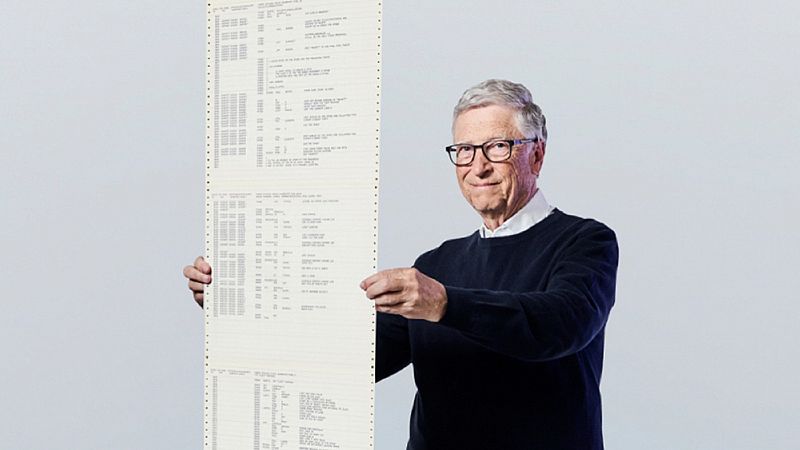
Even as he grows older, Microsoft founder Bill Gates still fondly remembers the catalytic computer code he wrote 50 years ago that opened up a new frontier in technology.
Even though the code that Gates produced on a teletype machine might seem primitive next to the technology driving modern AI systems, it was essential in establishing Microsoft back in April 1975—a milestone the firm based in Redmond, Washington, will mark this coming Friday.
At 69 years old, Gates initiated the celebration with a blog entry reflecting on how he and his former high school buddy—the late Paul Allen—struggled to establish the globe’s premier “software factory” following their read of an article in the January 1975 edition of Popular Electronics. The piece was about the Altair 8800, a minicomputer that would run using a small chip produced by the relatively unknown tech firm, Intel.
The article inspired Gates, who was just a freshman at Harvard University, and Allen to call Altair's maker, Micro Instrumentation and Telemetry Systems, and promise the company's CEO Ed Roberts they had developed software that would enable consumers to control the hardware.
The only problem was that Gates and Allen had not delivered the code they had assured Roberts they would provide.
'The most awesome code I've ever penned down'
Gates and Allen addressed the challenge by adopting the BASIC programming language, which was created in 1964 at Dartmouth College. However, they needed to devise a method for making this technology work seamlessly with the upcoming Altair computer, despite not having access to a functional model of the device.
Following two months of minimal rest while developing the software, Gates completed the code that formed the foundation for the Altair’s initial operating system.
Gates stated in his blog post, which offers an opportunity to download the original program, "That piece of code is still the most impressive one I have ever produced."
This code went on to establish the groundwork for a company that made personal computers ubiquitous in households worldwide. This was achieved through offering an array of software such as Word, Excel, and PowerPoint, along with theWindowsoperating system which continues to drive most PCs currently in use.
As he stated in the accompanying video, Gates referred to the code as 'the revolution.' He added that this innovation 'paved the way for personal computing,'
Part of Gates' nostalgia this year, as he gears up for his 70th birthday in October, involves recalling the code from those times.
The journey through nostalgia featured the release of his memoir in February, which delved into his formative years as a frequently misunderstood child who was largely friendless. It also celebrated the 25th anniversary of the charitable organization he established following his departure from Microsoft’s CEO role in 2000.
The technology behemoth faced initial setbacks following Gates' exit, yet it has flourished under the leadership of CEO Satya Nadella, amassing a market capitalization of approximately $2.8 trillion (€2.5 trillion).
In his memoir, Gates delved into his stormy relationship with the late Apple co-founder Steve Jobs, who cofounded one of the pioneers in personal computing. Next year marks Apple’s 50th anniversary.
Fifty years is indeed a significant period," remarked Gates, with his individual wealth assessed at approximately $108 billion (€98 billion). "It’s astounding that the vision became a reality.

Comments
Post a Comment