Eight European Countries Harness Renewables for Over Half Their Heating and Cooling Needs
Russia’s invasion of Ukraine continues to underscore the importance of energy security. Renewables play a key role in strengthening that security and diversifying energy sources.
The proportion of renewable energy sources has been increasing throughout Europe; however, it seems unlikely that numerous nations, especially those with the biggest economic powerhouses, will achieve the European Union’s goals for 2030.
Upping the amount of renewables The use of energy for heating and cooling structures is particularly crucial since these applications make up almost half of the European Union's overall energy usage, as reported by Eurostat.
So how much of Europe’s heating and cooling energy comes from renewables? And which countries are leading the way?
In 2023, renewable energy accounted for 26.2 percent of heating and cooling consumption within the European Union, which nearly reflects the percentage of renewables used across all types of energy in the region.
But this share varies widely across Europe - ranging from just 8 per cent in Ireland to 84 per cent in Iceland. Among EU members, Sweden and Estonia reported the highest shares, both at 67 per cent.
Why do some countries use more renewables in heating than others?
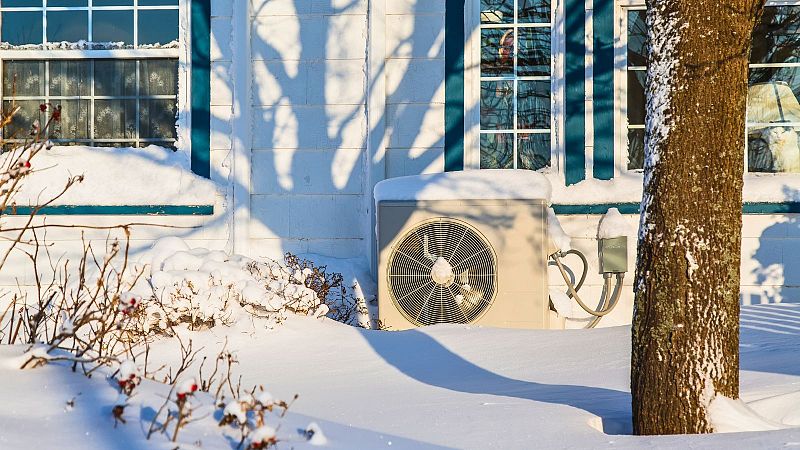
The data set encompasses various renewable resources such as solar power and geothermal energy, biofuels, the recyclable portion of waste materials, along with ambient heat that is harnessed from the environment. heat pumps for heating.
Various elements account for the disparities in renewable energy utilization for heating and cooling, as explained by Professor Pawel Oclon from the Cracow University of Technology in Poland to Euronews Green.
This encompasses factors like climatic circumstances, accessibility of resources, and the condition of energy infrastructures. Countries that have established fossil fuel frameworks encounter more challenging shifts. Supportive policies, financial investments, and available metropolitan areas likewise impact the advancement.
Specialists from the Institute for European Energy and Climate Policy (IEECP), including Ivana Rogulj, Jean-Sébastien Broc, Filippos Anagnostopoulos, Tomislav Novosel, Indriany Lionggo, and Stavros Spyridakos, emphasize that the scope of district heating plays an additional crucial role.
Nations with a significant portion of district heating often face an easier route when transitioning their heating systems towards lower carbon emissions. As they point out, "It is simpler to substitute a single large natural gas boiler with alternatives like a heat pump, biomass boiler, or recycled heat rather than replacing numerous separate boilers with heat pumps."
The leading positions are dominated by Nordic and Baltic nations.
The Nordic nations, excluding Norway, along with the Baltic states, top the charts in Europe regarding the utilization of renewable energy sources for both heating and cooling purposes. Each country has shown usage rates exceeding 54%, which is over twice the European Union’s overall average of 26%.
Rana Adib, the executive director of REN21—a global coalition involving governments, industry specialists, non-governmental organizations, and scholars—notes that these countries often possess sophisticated district heating networks. These systems frequently operate using renewable resources like geothermal power, recycled thermal energy, or, somewhat contentious among some groups, biomass .
Norway, by contrast, had a significantly lower share at 34 per cent. However, the IEECP experts suggest that Eurostat’s data on Norway may be misleading.
According to Eurostat, renewable electricity utilized to power heat pumps is excluded from the share of heating and cooling figures to prevent double-counting.
Experts highlight that over 90 percent of Norway’s electricity originates from hydropower and wind sources. They also mention that electricity is the primary means of heating in the country.
Leading economies in Western Europe fall short.
Many Western European nations, particularly those comprising the bloc's biggest four economic powers, exhibit notably lesser adoption of renewable energy sources for heating and cooling purposes.
Of these countries, only France (30 percent) stood marginally higher than the EU average of 26 percent, with all others falling beneath this benchmark. The percentages for the remaining nations consist of: Italy at 22 percent, Spain at 21 percent, Germany at 17 percent, Belgium at 11 percent, and the Netherlands at 10 percent. Ireland (8 per cent).
Based on data from Statista, only 7.5 percent of heating and cooling needs in the UK were met by renewable sources in 2018.
Adib notes that oil remains common in rural heating in Ireland, due to weak policies and minimal district heating. “Studies have shown that 54–57 per cent of total heat demand in Ireland could be met through district heating networks, yet implementation remains limited.”
The Netherlands has long relied on natural gas and has only recently begun a major effort to phase out gas boilers, she adds.
Belgium similarly depends greatly on natural gas and faces issues with sluggish progress in home renovations along with disjointed regional policies that impede effective collective efforts towards energy initiatives.
She credited the limited presence of renewable energy sources in Germany, France, Italy, and Spain to the prevalent dependence on individual systems. gas boilers The IEECP specialists additionally observe that electric heating has been encouraged in France because of the significant abundance of nuclear power.
Austria (39.4 percent) serves as a prime model among Central European nations regarding the implementation of renewable energy sources for heating and cooling purposes. According to IEECP specialists, "This impressive achievement stems from an established custom of utilizing biomass—both in standalone heating units and across large-scale district heating grids."
The majority of European Union candidate countries noted a greater percentage of renewable energy utilization in heating and cooling than the EU average, except for Albania (which had 23 percent). In contrast, Montenegro achieved a remarkable 67 percent.
Does Europe's advancement in renewable heating meet the requirements?
In the last twenty years, Europe has seen significant advancements in boosting the proportion of renewable energy used for heating and cooling—this figure climbed from roughly 11.7 percent in 2004 to about 26.2 percent by 2023, marking its peak so far. However, many experts believe this improvement falls short of what’s necessary.
"Although this progress is significant, it still falls short," Oclon states.
Regarding the EU’s non-mandatory objective of achieving a 49 percent share of renewables in buildings by 2030, Adib comments, "At this rate—approximately half a percentage point every year—it is much too gradual to achieve the bloc's environmental and energy goals."
The IEECP specialists highlight notable variations in advancement across different nations. They state, "A number of countries are unlikely to fulfill their commitments at this pace."
The line graph depicted above highlights the varying degrees of advancement throughout different parts of Europe.
What strategies can steer European nations onto the right path?
Professor Oclon suggests boosting funding for research to improve the effectiveness of various renewable energy technologies such as photovoltaic cells, solar thermal absorbers, heat exchangers, and power storage solutions.
Adib from REN21 mentions that several significant hurdles impede advancement, such as insufficient concentrated policies targeting the sector, prevalent usage of gas boilers, sluggish growth of infrastructure aligned with renewable energy sources, and fluctuating or inadequate motivational measures.
To speed up the implementation of renewable heating systems, she suggests specific policy measures aimed at advancing three primary technologies: electric heat pumps, carbon-free district heating, and solar thermal systems - both rooftop and extensive scale.
Is the European Union continuing to move away from Russian natural gas?
The European Union's energy strategy revolves around three main components: conserving energy, generating clean power, and broadening supply sources. A key aspect of this approach is decreasing reliance on Russian resources.
With this aim, the proportion of Russian pipeline gas shares in EU imports plummeted drastically -- from over 40 percent in 2021 to approximately 8 percent in 2023 -- after the invasion of Ukraine in early 2022.
In the combination of pipeline gas and liquefied natural gas (LNG), Russia represented under 15 percent of all EU gas imports, as reported by the European Commission. Nonetheless, this percentage increased to 18.9 percent in 2024.


Comments
Post a Comment