VP Dhankhar Calls for Urgent AI Regulation, Transparency, and Ethical Safeguards
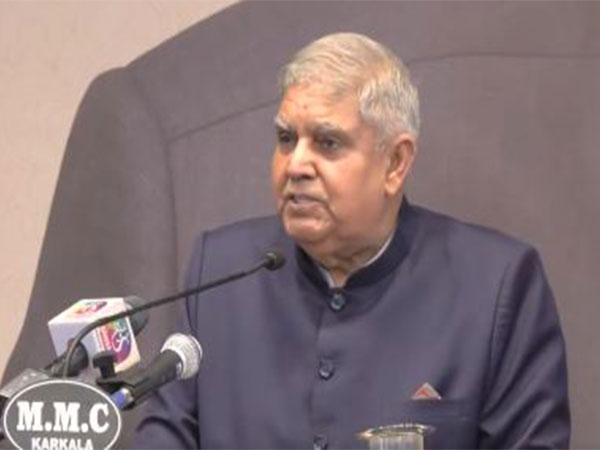
New Delhi [India], April 5 (ANI): The Vice President Jagdeep Dhankhar , at the time of AI on Trial's book launch, stressed the significance of maintaining a balance AI regulation With innovation comes the need to be wary of AI’s dangers, and there is an urgent call for a clear, worldwide strategy to safeguard public well-being, provide legal certainty, and promote the ethical application of AI.
Vice President Jagdeep Dhankhar spoke at an event where he released the book "AI on Trial," written by Rajya Sabha member Sujeet Kumar, which took place at his official residence. He stressed the importance of regulating artificial intelligence while ensuring a proper equilibrium between oversight and promoting technological advancement.
"The regulation of artificial intelligence will shape the type of society we aim to create. It has emerged as a crucial element that defines our future trajectory. Will we embrace a digital dystopia where individuals cater to algorithms, or strive for an inclusive Indian society where technology empowers the populace? This decision lies with us; the path forward is clear," observed VP Dhankar.
Vice President Dhankhar remarked, "Controlling Artificial Intelligence is challenging, terrifying, yet essential. A proper equilibrium must be achieved between regulation and advancement." artificial intelligence And promoting innovation is essential. Excessive regulations can stifle progress much like overly strict discipline hampers a child’s development. We shouldn’t hinder the entrepreneurial drive. However, we must also remain highly aware of the detrimental impacts. Insufficient regulation might jeopardize public safety, sustain biases, and diminish confidence.”
To control something as adaptable as this artificial intelligence , we require an adaptable and autonomous systemic structure at the national level. artificial intelligence An authority or commission, which operates independently yet remains answerable through representatives from government, industry, academia, and civil society, might function effectively as a think tank. Consequently, we ought to craft regulations as scaffolding rather than cages. The aim should be to establish a system that fosters responsible innovation while simultaneously thwarting malicious and harmful developments. Adopting an approach based on risk assessment, tailored to specific sectors, and grounded in principles would likely prove beneficial. For example, the degree of oversight necessary for artificial intelligence utilized in medical diagnoses should vary significantly from that applied to AI generating social media content....the impact of artificial intelligence At the core of the regulatory framework should be the needs of everyday people. Individuals cannot navigate these challenges alone. The system ought to offer built-in, automated assistance for regular citizens. We must safeguard our citizens from potential dangers. artificial intelligence , we need enforceable rights, such as the right to explanation and the right to contest automated decisions. Decisions are automated. How to contest them, we are not aware and the right to opt out of algorithmic processing, especially when decisions impact livelihoods, liberty, and dignity", the VP added.
VP Dhankar cautioned, "We have to be extremely wary also. AI, the genie is out of the bottle, and it can be extremely destructive. It can create havoc if not regulated. In the age of deep fakes, the workings of the Deep State, woke-ism, these menacing trends can get wings if this genie of Artificial Intelligence is not regulated. To put it simply, for young minds, nuclear power can give you energy. Nuclear power can lighten houses and run industries, but it can also be destructive, and therefore, we have both possibilities before us."
He further stated, "The regulation of artificial intelligence must be very transparent. It must go hand in hand with re-skilling and workforce planning. As artificial intelligence displaces certain tasks, it will. Because it has come to your house, come to your office. It does jobs sometimes better than normal resources, and then an impression is gathered. Are we risking the jobs of people who work? Maybe in some situations, this requires that we must invest very heavily in education, vocational training, digital literacy, particularly for those who are marginalised, who are vulnerable, who need hand-holding situations".
Underlining the importance of cyber sovereignty, VP Dhankar stated, "We must assert India's cyber sovereignty as much as we do the sovereignty understood in common parlance, but we have to be aligned to global standards. There can be no standalone activity in such situations. There will have to be global convergence. All stakeholders will have to come on one platform so that we have a global rule-based order in the field of Artificial Intelligence."
Speaking about the ramifications of AI in the legal domain, VP Dhankhar said, "Artificial intelligence has generated a compulsive scenario for us. It has forced us to re-examine existing jurisprudence. Traditional legal concepts like liability or even personhood come under pressure when actions are carried out by autonomous systems. Artificial intelligence opacity challenges legal transparency And accountability principles. Entrusting legal interpretation to opaque systems erodes judicial trust. If we rely on existing legal frameworks, artificial intelligence We identify a shortcoming: it lacks thorough regulation and supervision. There is a critical need for establishing standards and protections to avoid the outcomes of unchecked activity. artificial intelligence Debate persists worldwide regarding whether artificial intelligence fosters legal uniformity or upholds past prejudices....The danger to justice is severe; justice is endangered when algorithms devoid of human traits shape legislation, and rulings cannot be mechanized. There can be no artificial intelligence Replication. Occasionally, the difference is so subtle that it cannot be discerned even by artificial intelligence It is the mind of the judge, the perceptive mind, that discovers a solution.
Emphasising on the significance of meaningful consent, VP Dhankhar noted, "Our Digital Personal Data Protection Act is a landmark step, but it now has to evolve in tandem with artificial intelligence regulation. Consent must be meaningful; those who are lawyers know it. A consent that is not free is no consent in law and free means real freedom to give your consent. Consent cannot be buried in opaque and abstruse terms of service. I am sometimes surprised when I use my mobile phone and go to some application; there is pressure, and I agree. Now in utter helplessness, you concede a very personal ground. Unknowingly, you are lured or forced otherwise, the utilisation doesn't fructify with ease. Consent cannot be in opaque and abstruse terms of service. Anonymisation, data minimisation, and purpose limitation must be rigorously enforced." (ANI)

Comments
Post a Comment