Improving the performance of Cu₂SrSnS₄ solar cells with inorganic hole transport layers
Thin film solar cells such as CdTe and CIGSe have gained significant attention due to their low production cost and excellent power conversion efficiencies (PCE). Nevertheless, toxicity and scarcity of constituent elements restrict their widespread usage.
Recently, Cu 2 SrSnS 4 semiconductor has emerged as a potential substitute due to its remarkable absorber characteristics, including non-toxicity, Earth abundance, tunable bandgap, etc. But still, it's in the emerging stage with a low PCE of 0.6%, revealing that it requires remarkable enhancement to compete with traditional solar cells.
The large open circuit voltage (V OC ) loss constricts its performance, which primarily originates from improper band alignment with the transport layers. Discovering the ideal device configuration is the best solution to enhance its PCE.
Recently, SCAPS-1D simulation software has gained attention due to its reliability and the advantage of studying solar cell properties in less time without consuming material. In our work published in the Journal of Physics and Chemistry of Solids , we proposed several device configurations and comprehensively studied the performance of Cu 2 SrSnS 4 solar cells using SCAPS-1D.
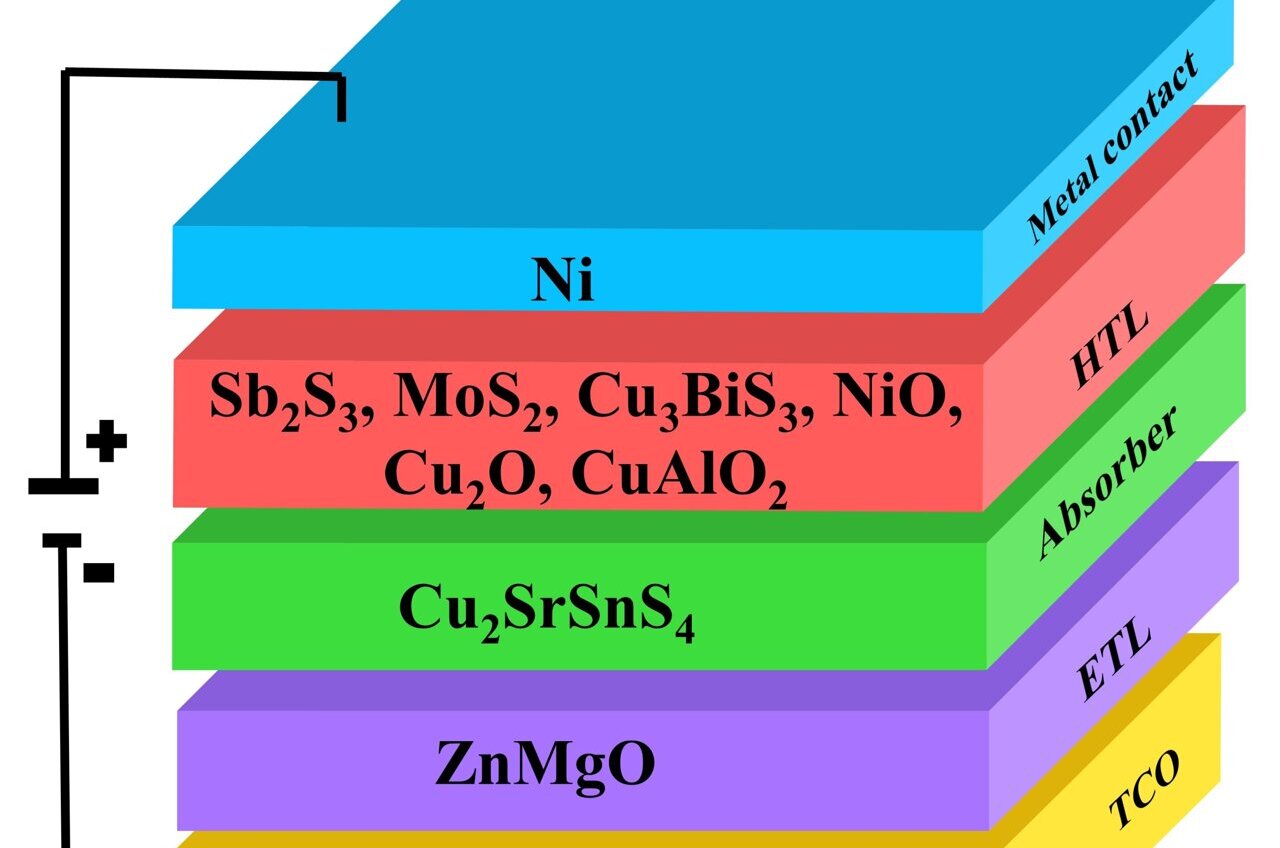
We designed six Cu 2 SrSnS 4 solar cells in superstate configuration based on chalcogenide and oxide-based hole transport layers (HTLs), namely Sb 2 S 3 , MoS 2 , Cu 3 BiS 3 , NiO, CuAlO 2 , and Cu 2 O, with ZnMgO as electron transport layer (ETL). In addition, we also designed solar cells without HTL to understand the significance of HTL in performance enhancement.
Their performance was broadly analyzed as a function of each layer's essential parameters, such as thickness, carrier density, defect density, and interface properties. The final results of these optimizations were remarkable. Addition of HTL elevated the PCE, and compared to the chalcogenide HTLs, the oxide HTL-based solar cells delivered higher performance with the champion PCE of 18.48% for Cu 2 O HTL.
We further conducted comparative analyses between the diverse HTL-based solar cells to discover the reason for the supremacy of Cu 2 O HTL over the others. The study focused on energy band diagrams, electric field, generation, recombination rates, Nyquist plots, and electron distribution of each solar cell extracted from SCAPS-1D.
We identified that Cu 2 O solar cells had perfect band alignment at the interface of absorber and HTL with hole and electron barriers of -0.04 eV and 0.46 eV. Additionally, it displayed a higher electric field on the negative side, a large recombination resistance of 9.4×10 5 Ω.cm 2 and a low V OC deficit compared to others.
In conclusion, our work delivers promising guidelines for the photovoltaic community to understand the importance of HTL in improving the efficiency of solar cells. So, we believe that the fabrication of Cu 2 SrSnS 4 solar cells with the champion device structure FTO/ZnMgO/Cu 2 SrSnS 4 /Cu 2 O/Ni would enhance the PCE of Cu 2 SrSnS 4 solar cells in the future.
This story is part of Science X Dialog , where researchers can report findings from their published research articles. Visit this page for information about Science X Dialog and how to participate.
More information: Kaviya Tracy Arockiadoss et al, Architecture guidelines for Cu2SrSnS4 solar cells using chalcogenide and oxide hole transport layers by SCAPS-1D simulation, Journal of Physics and Chemistry of Solids (2025). DOI: 10.1016/j.jpcs.2025.112732
Dr. Latha Marasamy is a Research Professor at the Faculty of Chemistry at UAQ, where she leads a dynamic team of international students and researchers. Her mission is to advance renewable energy, particularly in the development of second and third-generation solar cells, which include CdTe, CIGS, emerging chalcogenide perovskites, lead-free perovskites, quaternary chalcogenides of I2-II-IV-VI4, and hybrid solar cells. She is working with a range of materials such as CdTe, CIGSe, CdS, MOFs, graphitic carbon nitride, chalcogenide perovskites (ABX 3 , where A = Ba, Sr, Ca; B = Zr, Hf; X = S, Se), quaternary chalcogenides (I2-II-IV-VI4, where I = Cu, Ag; II = Ba, Sr, Co, Mn, Fe, Mg; IV = Sn, Ti; VI = S, Se), metal oxides, MXenes, ferrites, plasmonic metal nitrides, and borides for these applications. Additionally, Dr. Marasamy is investigating the properties of novel materials and their influence on solar cell performance through DFT and SCAPS-1D simulations.
This story was originally published on Tech Xplore . Subscribe to our newsletter for the latest sci-tech news updates.
Comments
Post a Comment