Labour promises to find almost £14billion a year in Whitehall savings
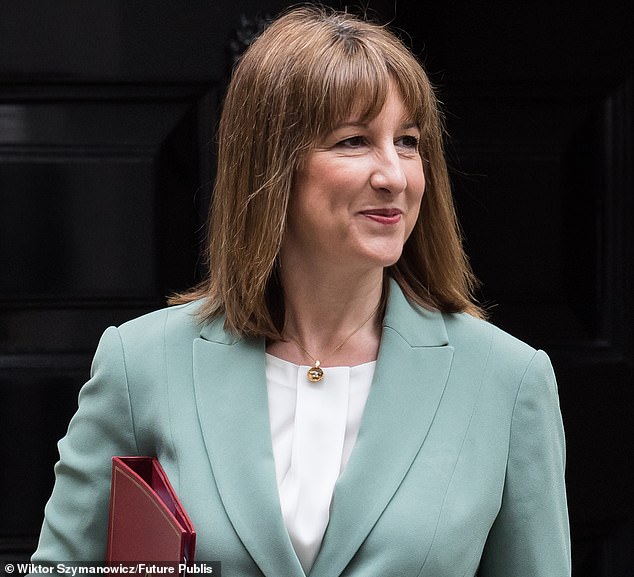
Labour today promised to find almost £14billion a year in Whitehall savings as part of Chancellor Rachel Reeves ' spending plans.
The Office for Value for Money, established by Ms Reeves last October, has worked with each Government department to find where they can save cash.
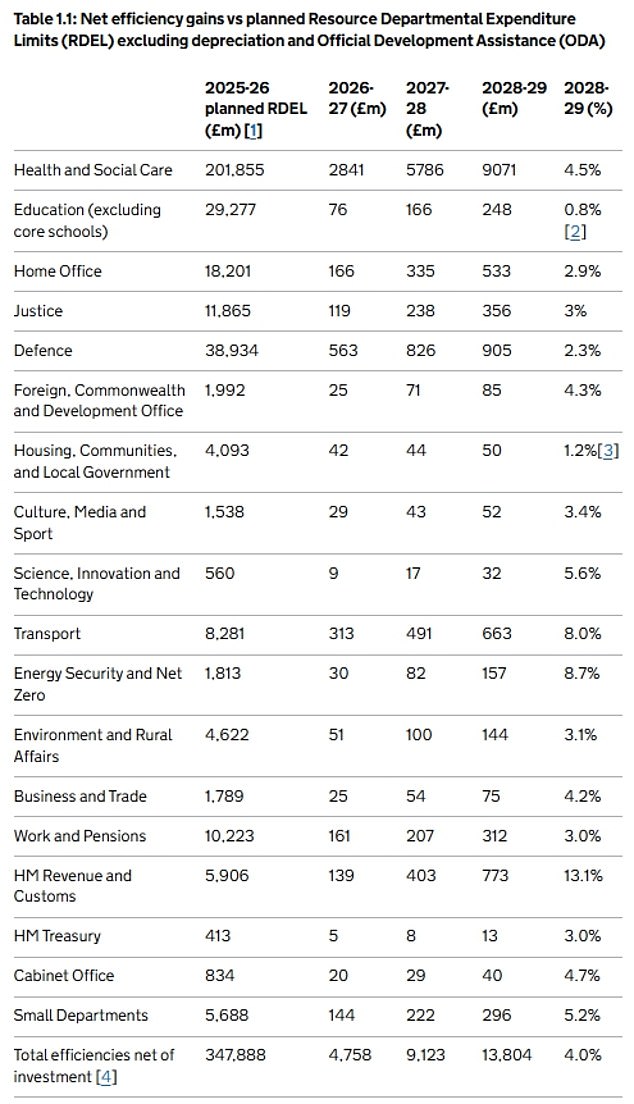
As part of the Chancellor's spending review, it was revealed these plans had found 'total annual efficiency gains of almost £14billion by 2028-29'.
These will be through 'a combination of improved outcomes and reduced cost', with most departments vowing to deliver efficiencies of at least 3 per cent within four years and some delivering over 8 per cent.
The Treasury set out how civil service job cuts, greater use of Artificial Intelligence ( AI ), and flogging off Government property lay at the heart of the savings plans.
It comes after Prime Minister Sir Keir Starmer used a speech in March to outline his bid to tackle the 'flabby state' with a programme of Whitehall reforms.
Ahead of Ms Reeves spending review, which she announced to MPs on Wednesday, departments had been told to find 5 per cent savings and efficiencies by 2028-29.
They were also told to reduce administration budgets by at least 16 per cent in real terms by 2029-30.
At her Spring Statement in March, the Chancellor promised £150million to cover civil service redundancy costs as part of voluntary exit schemes.
A Treasury document accompanying Wednesday's spending review set out how departments were intent on finding efficiencies through digital investment, workforce reform, and by reducing the size of the Whitehall estate.
The Home Office said it would, in part, find efficiency gains of £533million per year by 2028-29 through increased automation and use of AI.
It said this would 'reduce reliance on manual processes so staff time can be focused on more complex tasks'.
The Ministry of Justice, Department for Science, Innovation and Technology, Department for Environment, Food and Rural Affairs, and Cabinet Office all detailed how their savings plans were partly based on reducing headcount.
Meanwhile, the Foreign Office suggested it would maintain a stronger grip on salaries.
The department said it would 'tighten grading standards to ensure roles are accurately, independently and consistently evaluated and appropriately remunerated'.
The Office of Government Property was said to be 'supporting departments to streamline the government estate'.
This included 'reducing the size of the London estate and making better use of government owned land'.
The Department for Transport said it would 'rationalise its London estate' and expand its presence in Leeds and Birmingham.
HMRC pledged to reduce its estate in central London by 25 per cent, while the Cabinet Office said it would 'move roles from Westminster to Canary Wharf in outer London where estates costs are half that of the buildings in Westminster'.
Last month, the Government promised to cut the number of civil servants working in London by 12,000 and shift jobs to a series of new regional campuses.
The changes will also see 11 Government office buildings in London close, in a move expected to save £94million a year by 2032.
Among the offices being closed is 102 Petty France, one of the largest Government offices in the capital.
It is home to around 7,000 civil servants in the Ministry of Justice, HM Courts and Tribunal Service, Crown Prosecution Service and the Government Legal Department.
The Government will also close 39 Victoria Street, which has been home to the Department of Health and Social Care since the end of 2017.
Read more
Comments
Post a Comment